
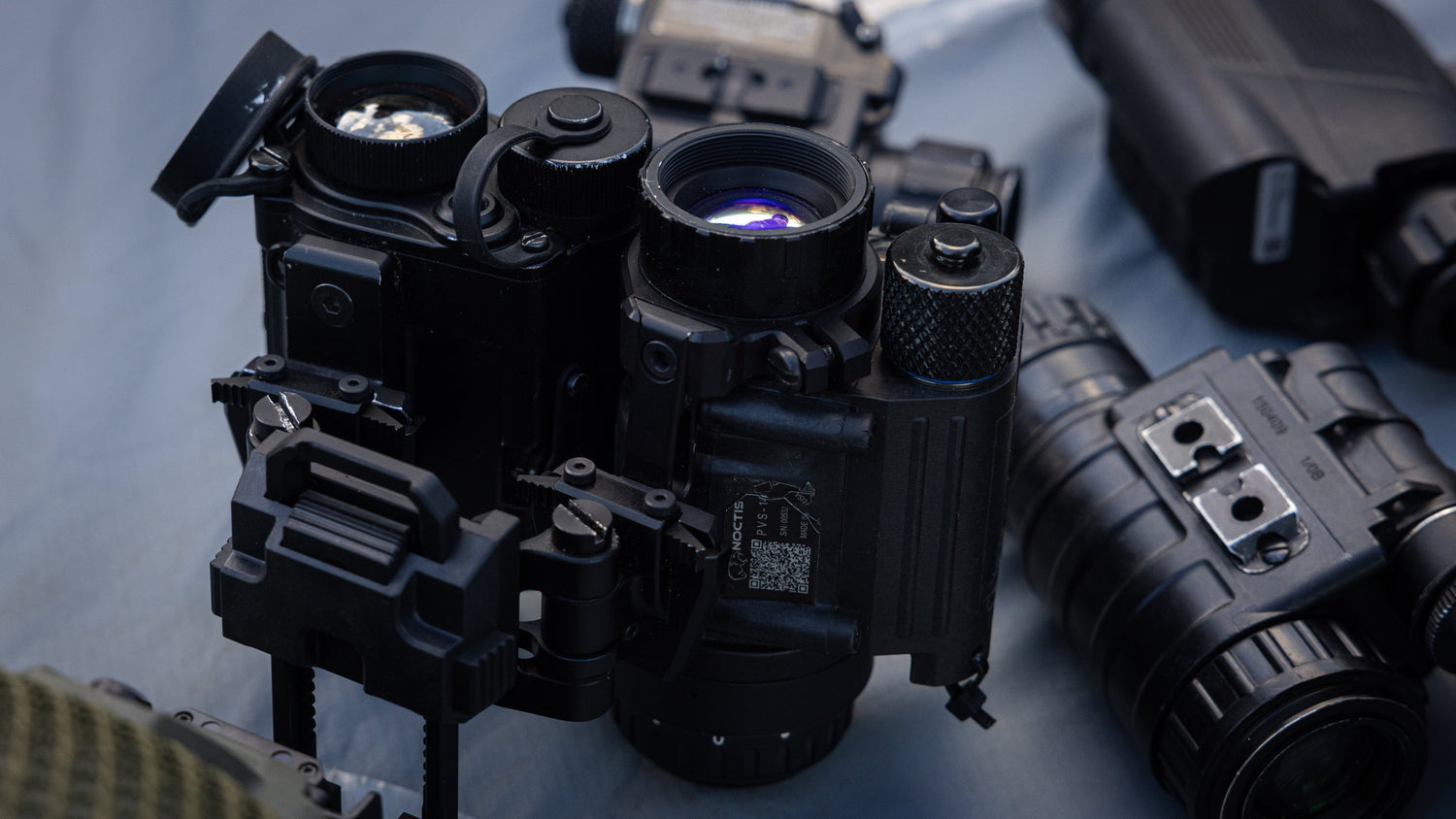
If you can only afford one device, buy the thermal first. That answer surprises people, because night vision is the thing everyone pictures when they think about seeing in the dark. But detection is what wins at night, and thermal detects better than any tube ever will. Night vision comes second, as the tool you move and navigate with once a thermal already tells you where to look.
That's not a hot take we made up for a blog post. It's the standing advice our support team gives every week, and we've tested it on camera more than once.

The test that settled it for us
We ran a series of field trials where an experienced operator with premium night vision went up against a total beginner carrying a cheap thermal. Three scenarios: a static observation post, an advance to contact, and defending a position. The beginner with the thermal won all three. As we put it in the video: "You can take somebody that does not have a lot of training. You can explain him thermal in like 10-15 minutes and he can actually already go to work."
We repeated the idea with matched budgets in Thermal versus Night Vision: Tactical Scenarios: one player running a night vision binocular, the other running a monocular bridged with a dedicated thermal, similar total cost. The thermal setup found and "lased" the bino user from 300-400 metres away without ever being spotted in return. Final score, in our own words from the video: "basically the result was three and 0 for the thermal."
The physics behind it is simple. A night vision tube amplifies the light that's already there, so a person standing still in a dark tree line stays part of the dark tree line. We showed this in our tube comparison video: even with three different high-end tubes, a man simply standing in a dark backyard was basically invisible to all of them. A thermal doesn't care about light at all. It sees his body heat glowing against the cold background.
So why does anyone buy night vision?
Because thermal is a detection tool, not a movement tool. Thermal gives you a flat, low-detail picture. You can't read terrain depth well, you can't identify faces or gear, and walking through forest with only a thermal is miserable. Night vision gives you depth, detail and natural navigation. Under night vision you can walk, drive, climb and shoot. Under thermal you mostly stop and scan.
That's why the end goal for most serious users is both: tube for moving, thermal for finding. Our whole bridge and mount ecosystem exists to put the two side by side on one helmet.
The buying order we recommend
This is the doctrine we use with airsoft and milsim customers, and it holds for most hunters and collectors too:
- Thermal first. A helmet-capable thermal like the Jerry-YM 2.0 or the Falcon 640+ V2 changes what you can find at night more than any tube upgrade ever will.
- Then night vision. Start with a solid monocular. Our FC-PVS14 kit is the entry point we point most people at.
- Tube grade last. Only chase higher tube specs once you already have both capabilities. A better tube is a refinement, not a new ability.
One caveat on that third point: mil-spec tubes exist mainly to survive real gunfire and hard military use. For airsoft, that durability premium is not worth it.
Quick answers to the questions we actually get
Is a thermal overlay a substitute for a dedicated thermal?
Partly. A clip-on overlay like our FTO 640 projects thermal highlights into your existing night vision tube, so one device on your face does both jobs. It's the best upgrade for someone who already owns a good monocular or binocular. A dedicated thermal still wins on raw detail and detection range, which is why range matters when choosing between them.
What tube spec is "good enough"?
For a monocular, 1800 FOM is the minimum we recommend. For binoculars you can go lower, our FC-B 1400+ works because using both eyes compensates in a way one eye can't. And FOM alone doesn't tell the whole story: in our tube comparison, a lower-FOM US Gen 3 tube kept up with, and sometimes beat, higher-FOM European tubes in real darkness.
Does a higher-grade tube even matter for me?
It matters most far away from light pollution and at longer ranges. If you play in and around buildings or near towns, ambient light does a lot of the work and a mid-grade tube looks nearly identical to a premium one.
Cheap night vision from Temu or Amazon, worth it as a starter?
No. We bought a pile of them and tested them on camera. They're digital cameras with IR flashlights, not image intensifiers, and a normal flashlight honestly beats them. There is no such thing as cheap night vision.
My two cents
People fixate on night vision first because it looks cooler and it's what the movies show. But every time we put both technologies in the field, the same thing happens: the thermal user finds everyone, and the night vision user walks past people standing ten metres inside a shadow. Buy the ability to find things first. Buy the ability to move comfortably second. Then, if the budget still has life in it, start arguing about tube specs.
Not sure which thermal or tube fits your situation? Ask us through the chat on any product page. Real people from the range answer, and we'd rather talk you out of the wrong purchase than ship it.

Leave a comment
This site is protected by hCaptcha and the hCaptcha Privacy Policy and Terms of Service apply.